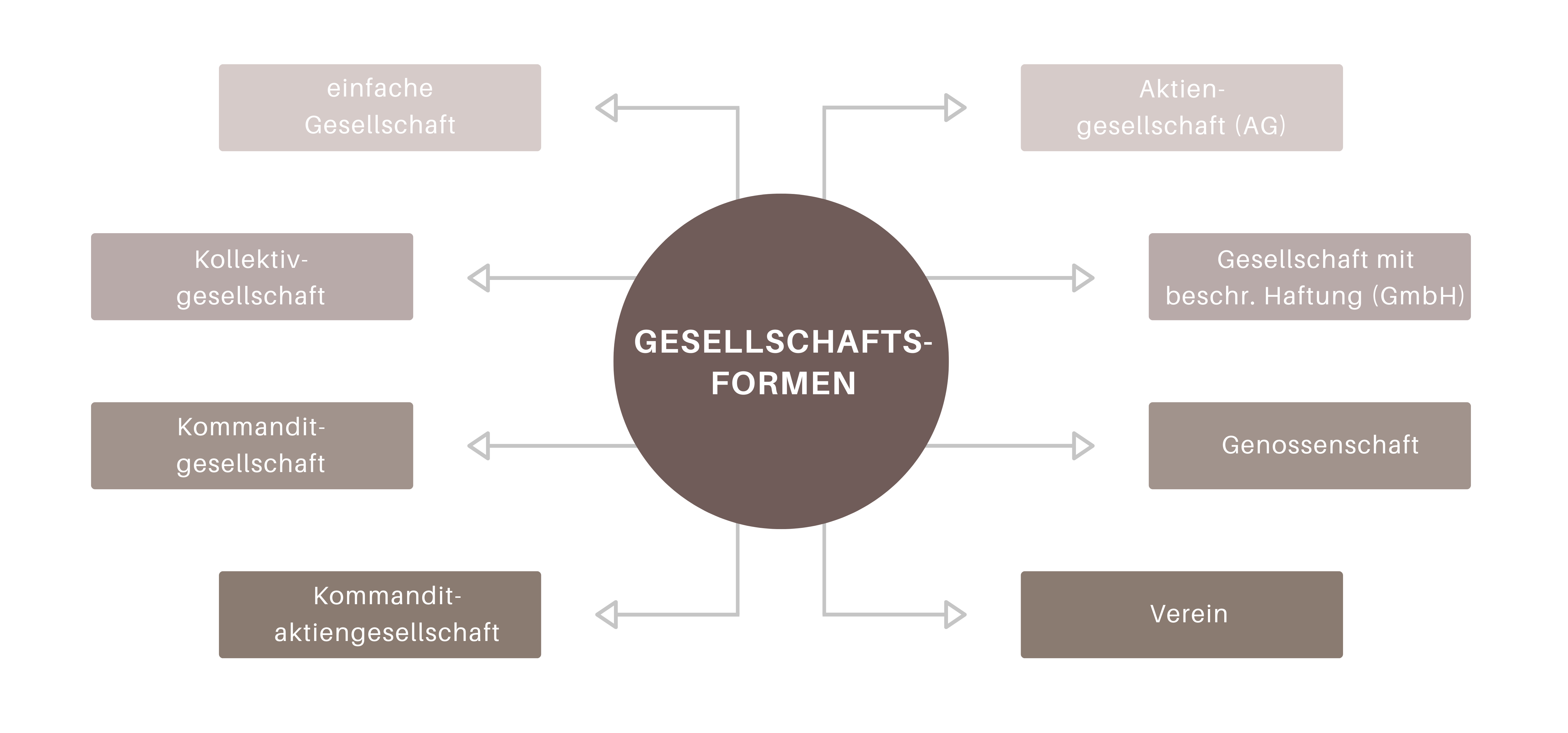
A key distinguishing criterion between different types of companies lies in personal liability. While personal liability exists in partnerships such as sole proprietorships, simple partnerships, and general and limited partnerships, liability in capital companies like public limited companies (AG), limited liability companies (GmbH), or cooperatives is limited to the company’s assets. In return, the establishment of partnerships is often significantly less complex than that of capital companies.
It is advisable to seek comprehensive legal advice before choosing the appropriate company form. This ensures that all legal aspects are taken into account and the most suitable option can be selected. As lawyers and notaries in the Canton of Lucerne, we are happy to assist you in making this decision and provide you with thorough guidance.
How do I start a business in Switzerland?
Starting a business offers various advantages, whether through limited liability in capital companies or the unification of individuals for a common purpose in partnerships. Regardless of the chosen form, the following steps must be followed during the establishment process:
- Choosing the Legal Form: The founding process varies significantly depending on the selected legal form. Therefore, the first step should be to choose the appropriate legal form from the legally prescribed company types.
- Choosing a Company Name: There is considerable freedom in selecting a company name; however, certain legal requirements must be observed, such as including the company form at the end of the name (e.g., "AG" for a public limited company).
- Public Notarization: Depending on the chosen company form, the establishment must be publicly notarized by a notary. In the case of capital companies, the capital must already be contributed through cash or non-cash contributions or set off at this time.
- Registration with the Commercial Register: Depending on the type of company, the company acquires legal capacity only after registration with the commercial register. For certain types of companies, registration may be voluntary.
The Beeler & Marbacher law firm and notary office has supported numerous companies on their path to establishment. We would be happy to assist you with our extensive expertise.
How much capital do I need to establish an AG or GmbH?
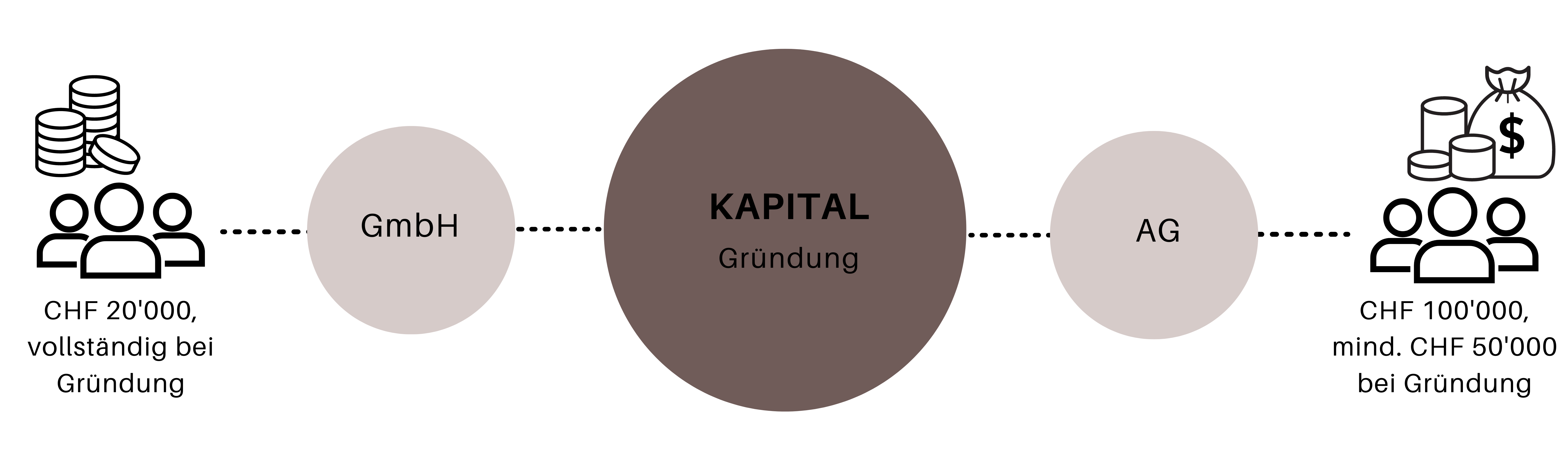
The amount of capital required for the establishment of an AG or GmbH varies. For an AG, a capital of CHF 100,000 is required, while for a GmbH, it is only CHF 20,000. Unlike the AG, however, the capital must be fully paid up at the time of establishment for the GmbH. In the case of the AG, the contribution must be at least 20 percent of the nominal value of each share, but at least CHF 50,000.
The contribution can be made in the form of cash contributions, contributions in kind, or set-off against a receivable.
Cash amounts must be deposited in a bank for the exclusive disposal of the company. The bank will only release the amount once the company is registered in the commercial register.
Items contributed in kind are considered valid if they can be recognized as assets on the balance sheet, can be transferred to the company’s assets, the company can freely dispose of them as owner immediately after its registration in the commercial register, and they can be liquidated through transfer to third parties. Contributions in kind must be agreed upon in writing or, in the case of real estate, must be publicly notarized.
Receivables can be set off if they are monetary or similar performance obligations, the receivable is due, and a declaration of set-off exists.
The Beeler & Marbacher Law Firm and Notary Office is pleased to provide you with comprehensive advice on the various financing options and their advantages and disadvantages.
What restructuring options are available for companies?
After the establishment of a company, situations may arise that necessitate a change in the corporate structure. If the restructuring is to be internal, this can be achieved through:
- Capital increase,
- Introduction of a capital band, or
- Capital reduction.
For inter-company changes, the Merger Act defines various options for action, including:
- Merger,
- Split-up,
- Transformation, and
- Asset transfer.
With our extensive expertise, the Beeler & Marbacher Law Firm and Notary Office can support you effectively throughout the restructuring process. We are well aware of the advantages and disadvantages of each course of action and are happy to advise you.
Notary Beeler & Marbacher - Your Contact for Foundation/Restructuring in Lucerne
Beeler & Marbacher Law Firm and Notary Office is the ideal choice for corporate law matters. Are you looking for experienced and straightforward professionals for company formations or restructurings? We are here for you as notaries in the Canton of Lucerne and lawyers with extensive expertise in this area. Thanks to our many years of experience and our commitment to tailored solutions, you can rely on first-class advice and professional notarizations.
With us, you have a keen partner,
- who listens to you and quickly understands your goals and objectives,
- with whom you can express your personal ideas,
- who presents you with various options for action, and
- who ensures compliance with the relevant regulatory requirements.

Do you have any questions regarding real estate transactions? Then do not hesitate to contact us:
We charge according to the Notarization Fees Ordinance. A breakdown of the prices can be accessed via the following link.